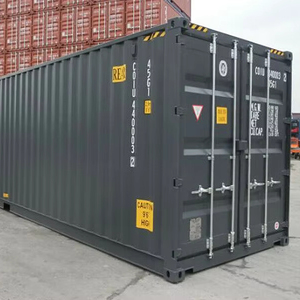
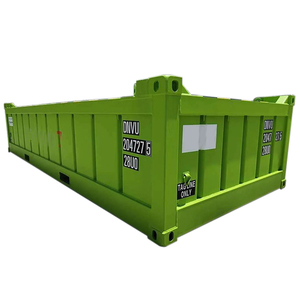
Sea Shipping Cargo Second Hand 20/40/45GP Reefer/Flat Rack/Open Top Side Open Containers
- Structural Grade: CSC Certified Cargo Worthy
- Payload Capacity: Up to 45,000 kg (Flat Rack)
- Utility: Out-of-Gauge (OOG) & Project Cargo

Engineered for extreme payloads, offshore energy infrastructure, and intermodal breakbulk logistics across Saudi Arabia, the GCC, and global maritime corridors.

Navigating complex project cargo demands rigorous axle load distribution, advanced structural integrity calculations, and seamless multi-modal execution.
Standard logistics models frequently fail when transitioning from normal containerized freight to Heavy Lift and Out-of-Gauge (OOG) haulage. True project cargo resilience relies on absolute engineering precision: calculating exact Center of Gravity (CoG) parameters, structural bending moments on multi-axle hydraulic trailers (SPMTs), dynamic sea-fastening load limits under Roll/Pitch/Heave conditions, and navigating localized regulatory bottlenecks such as Saudi Arabia’s MOT (Ministry of Transport) permits and SABER conformity declarations.
Preventing structural overload on civil bridges and specialized trailers requires precise point-load simulations. Our heavy transport engineers evaluate wheel load allocations, hydraulic suspension grouping, and ground bearing pressure to ensure zero infrastructure damage during transit.
Utilizing state-of-the-art Self-Propelled Modular Transporters (SPMT) with electronic multi-mode steering allows precision maneuverability within tight refinery yards, offshore fabrication facilities, and congested port terminals.
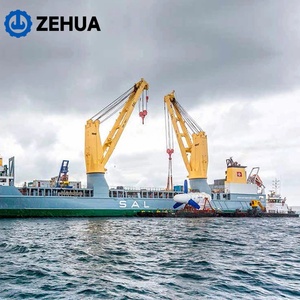
Offshore vessel charters demand customized sea-fastening calculations complying with DNVGL-ST-N001 standards. We analyze wave action acceleration, wind drag, and friction factors to design custom structural steel stoppers and high-tensile lashing grids.
Operating as a single accountable entity across Saudi Arabia, the GCC, and international trade routes. We eliminate multi-vendor friction by handling sea freight, customs clearance, heavy transport, and site staging under one operational file.
Direct integration with FASAH, SABER, and SFDA regulatory portals. Our licensed clearance officers process complex heavy machinery documentation, avoiding costly demurrage at Dammam, Jubail, and Jeddah ports.
Operating custom lowbed trailers, extendable flatbeds, multi-axle hydraulic modules, and heavy cranes. Full asset control ensures immediate dispatch reliability for time-critical energy and industrial projects.
Seamless sea and land operations covering both the Arabian Gulf (Dammam, Jubail) and Red Sea (Jeddah, King Abdullah Port, Yanbu) gateways, with optimized inland road corridors across the GCC.
Eliminating communication gaps between shipping lines, customs brokers, and hauliers. One dedicated project manager oversees your cargo from ex-works origin loading to final site foundation placement.
Analyzing global procurement shifts, regulatory evolutions, and technological advances transforming project cargo and heavy lift haulage from 2026 to 2035.
Future procurement contracts increasingly require real-time strain-gauge telemetry, dynamic tilt sensing, and GPS vibration tracking integrated directly into heavy lift trailers and marine deck lashings during transit.
Global EPCs are moving away from site assembly, preferring hyper-large pre-fabricated modules (over 1,000 tonnes). Sourcing strategies now prioritize hauliers with high-tonnage SPMT fleets and dedicated Ro-Ro berths.
Offshore oil rig operators and green hydrogen developers enforce strict compliance with DNV 2.7-1 certification for cargo baskets, portable ISO tanks, and knuckle boom cranes to guarantee zero environmental loss.
Decarbonization mandates are driving the adoption of bio-fuel powered heavy haul prime movers and electro-hydraulic auxiliary power units (APUs) on marine cranes, lowering the carbon intensity of mega-project supply chains.
In-depth answers addressing structural specifications, regulatory frameworks, maritime safety standards, and project cargo execution.
Flat Rack and Open Top containers are specifically engineered for Out-of-Gauge (OOG) and heavy industrial freight that exceeds standard container dimensions. Flat Racks feature high-tensile steel end walls with no side or top structures, allowing top-loading or side-loading of massive machinery, rotary equipment, and heavy vehicles up to 45 tonnes. Open Top containers allow overhead crane loading of tall equipment while maintaining standard twist-lock corner casting securing mechanisms for ocean vessel stowage.
DNV 2.7-1 (and EN 12079) is the international standard governing offshore portable units lifted at sea. Offshore environments subject cargo containers to extreme dynamic forces, corrosive saltwater exposure, and severe impact during vessel-to-rig transfers. DNV 2.7-1 certified containers undergo rigorous non-destructive testing (NDT), possess dedicated certified sling sets, and are structurally rated to withstand harsh offshore mechanical stresses without catastrophic frame failure.
Dangerous cargo transport requires comprehensive adherence to the International Maritime Dangerous Goods (IMDG) Code. This includes verified Material Safety Data Sheets (MSDS), UN-approved protective packaging, specialized hazard labeling, segregation from incompatible materials on board, and advance maritime port authority declarations. Nuraak Gulf ensures complete regulatory compliance across all major hazard classes (IMO 2 through 9), mitigating port detention risks.
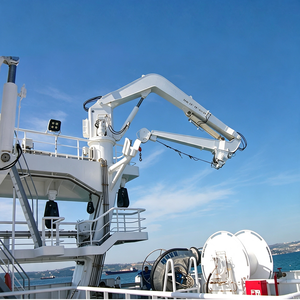
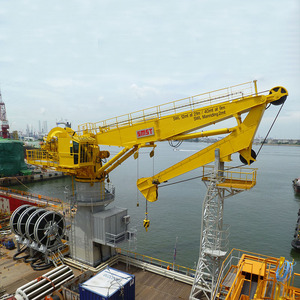
Selecting an offshore marine crane (knuckle boom or fixed boom) requires calculating the maximum operational payload, required working radius (outreach), sea state conditions (significant wave height Hs), dynamic amplification factors (DAF), and pedestal mounting load tolerances. Offshore knuckle boom cranes provide high flexibility by minimizing load swing and maintaining precise control during vessel deck transfers under active wave motions.
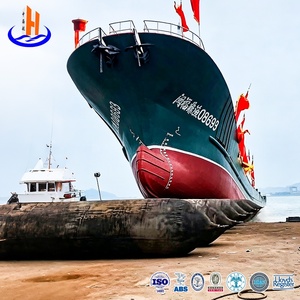
Marine rubber airbags made from synthetic-tire-cord layers offer high flexibility and load-bearing capacities (exceeding 10,000 tonnes total lift). They act as pneumatic rollers beneath heavy ship hulls, oil rig structures, or caissons, enabling smooth transfer between land slipways and floating barges without requiring expensive dry docks or heavy crane infrastructure. Their elasticity absorbs structural shocks and surface irregularities during movement.
Inland movement of abnormal loads requires Ministry of Transport (MOT) special movement permits, Traffic Police escorts, route bridge structural approvals, and overhead utility line height clearances. Additionally, imported heavy machinery requires customs clearance through the FASAH portal and product conformity certificates via SABER prior to port dispatch. Nuraak Gulf handles all permit acquisition and route surveys in-house.
Whether importing heavy machinery, chartering breakbulk vessels, or securing DNV offshore containers, our engineering operations team provides complete landed plans and quotes within the same working day.
Send an Inquiry